

Two-way radios are a simple and reliable form of communication, whether you're using them for business or leisure. One type of radio that's very popular, especially among leisure users and small businesses, are licence-free radios. Why? There's virtually no set-up needed, they're simple to use, and they're a cost-effective option compared to some other types of radio.
This guide explores everything you need to know to decide whether a licence-free radio is right for you. We'll look at who they're suited to, their benefits and drawbacks, and the radio frequencies they operate on. We'll also draw on our many years of experience to share our recommendations for the best licence-free radios currently available.
What are licence-free radios?
Two-way radios (and the VHF or UHF frequencies they operate on) are governed, licensed and co-ordinated by Ofcom in the UK. But not every two-way radio has to be licensed; some can operate on designated frequencies that don't require a licence. This is the group of radios known as licence-free radios. Let's learn a few facts about them.
- Licence-free radios are sometimes called PMR446 radios. PMR stands for Personal Mobile Radio. 446 refers to the UHF frequency range 446MHz, designated for short-range communication, on which licence-free radios are permitted to operate. See the full list of operating frequencies for licence-free radios below.
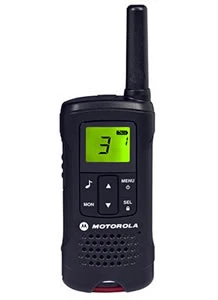
- Licence-free radios are generally lower-powered, handheld radios. They have a maximum power output of 0.5 Watts. This gives them a much shorter range than their licensed counterparts.
- Licence-free radios are more often referred to as "walkie-talkies" than their higher-powered, licensed counterparts. It doesn't matter whether you call them walkie-talkies or two-way radios.
- Depending on the surrounding terrain, the range can vary from a few hundred metres in a built-up area to a few kilometres in open ground. Typically, think line-of-sight range for outdoor activities on a small site.
- You can use licence-free radios for business or personal use only on a specific range of 16 UHF frequencies within the 446MHz range, both in the UK and across the European Union.
- Licence-free two-way radios are manufactured with the permitted range of frequencies already programmed in, so they're ready to use straight away.
- It's illegal to program a licence-free radio to any frequency other than those permitted in the 446MHz range. Manufacturers of licence-free radios usually restrict a user's ability to modify the radio to other frequencies.
- If you're not sure whether you need a licence for your radio, you should read Licences for Two-Way Radios - Do You Need One?
- Power sources can vary, from basic models which use AA cells, to more advanced models which use Li-Ion rechargeable packs.
- In the USA and Canada, the closest equivalent to a licence-free option is FRS or GMRS.
Benefits of a licence-free radio
- Less expensive than licensed radios - For example, you can buy the Motorola T62 Talkabout Twin Pack for just £35 currently (£42 inc. VAT). You get far more features than you might think on this model. Even at the upper price point, you have some really cost-effective options. Take the Icom IC-F29DR3 Professional Radio for example. For just £192 (230.40 inc. VAT), this radio has a long list of professional features, including a water- and dustproof IP67 rating, dual analogue and digital modes, safety features, up to 26 hours operating time and powerful audio output.
- Easy to use - Easy-to-navigate buttons for simple operation. Just unbox it, charge it and start using it.
- Pre-programmed radio frequencies - As mentioned above.
- No call charges - Transmissions are free over UHF / VHF radio waves.
- No contracts - Unlike mobile phones.
- Rechargeable versions give good operating time
- New digital technology has improved voice quality and performance
- No licence required! Negligible running costs
- Operate throughout the UK and in most EU countries - you can take a licence-free radio out of the UK and use it legally in most EU countries that use PMR446 as standard (check before you go).
 Disadvantages of licence-free radios
Consider the few limitations of licence-free radios before making a commitment:
- Lower power - With a maximum output of 0.5 Watts, their range is shorter (typically, a maximum of approximately 3km).
- Channel congestion - Their popularity means that too many users are often trying to transmit on the same channel. This congestion can lead to interference, poor signal quality, and potential disruptions in communication.
- Privacy concerns - Users within range can access the same channel as you, making licence-free radios unsuitable for situations requiring privacy or secure communication in crowded areas. Business users in particular may be concerned about intercepted transmissions.
- Not suitable for emergency use - Channel usage on licence-free radios is available on a first-come-first served basis, which means you can't guarantee reliable communication in an emergency.
- Interference - If users are too far apart you may suffer interference from other two-way radios within range.
Who might use them?
There is a huge range of possibilities for the use of licence-free radios, for example:
- Construction workers
- Event managers
- Hotel and tourist attraction operators
- Neighbourhood watch coordinators
- Factory workers
- Farm and country estate workers
- Leisure use (hiking, cycling, camping, orienteering, shoots etc.)
Are licence-free radios the right choice for you?
Licence-free radios are the right choice if you need a simple, cost-effective communication solution for personal use, small-scale operations, or recreational activities where a short range and potential for interference are not a major concern. They are cheaper to buy, require no licence, and are easy to operate; however, their low power and restricted range means that for professional or wide-area use, where reliable, long-range communication is essential, a licensed radio is usually better suited due to its greater range and privacy features.
Are they easy to use?
Walkie-talkies really are easy to operate, especially the cheaper, licence-free varieties, as they tend to have fewer functions than their licensed, more technically advanced counterparts. Start by making sure both sending and receiving radios are switched on and tuned to the same channel - there will be a channel selector button on the radio. Remember, unlike a mobile phone, only one person at a time can speak. The large Push-to-Talk button does exactly that - when you push it in, you're transmitting. Release the PTT button when you've finished speaking, and if the other person then wants to reply, they do exactly the same.
UK radio frequencies for licence-free radios
After January 2018, the PMR frequency spectrum was expanded (from just eight channels) in line with Harmonised European Standards to create greater capacity across Europe.
There are two main types of PMR446 radios: analogue and digital. Both types use the same frequency range but differ in the number of channels and spacing:
Analogue PMR446
- Operates on 16 channels
- Channel spacing is 12.5 kHz
- Frequencies range from 446.00625 MHz to 446.19375 MHz
Digital PMR446 (dPMR446)
- Can use 16 channels at 12.5 kHz spacing or 32 channels at 6.25 kHz spacing
- Still operates within the 446.0 to 446.2 MHz band
- Offers improved audio quality and privacy compared to analogue
Channel Spacing Summary
- Analogue: Fixed at 12.5 kHz
- Digital: Either 12.5 kHz or 6.25 kHz, depending on the model and standard (e.g., dPMR446)
Here's a table showing the whole spectrum of PMR446 frequencies, with the channel plan.
| Analogue (12.5 kHz Channel Spacing) | Digital dPMR446 (6.25kHz Channel Spacing) | ||
|---|---|---|---|
| CH1 | 446.00625MHz | CH1 | 446.003125MHz |
| CH2 | 446.01875MHz | CH2 | 446.009375MHz |
| CH3 | 446.03125MHz | CH3 | 446.015625MHz |
| CH4 | 446.04375MHz | CH4 | 446.021875MHz |
| CH5 | 446.05625MHz | CH5 | 446.028125MHz |
| CH6 | 446.06875MHz | CH6 | 446.034375MHz |
| CH7 | 446.08125MHz | CH7 | 446.040625MHz |
| CH8 | 446.09375MHz | CH8 | 446.046875MHz |
| CH9 | 446.10625MHz | CH9 | 446.053125MHz |
| CH10 | 446.11875MHz | CH10 | 446.059375MHz |
| CH11 | 446.13125MHz | CH11 | 446.065625MHz |
| CH12 | 446.14375MHz | CH12 | 446.071875MHz |
| CH13 | 446.15625MHz | CH13 | 446.078125MHz |
| CH14 | 446.16875MHz | CH14 | 446.084375MHz |
| CH15 | 446.18125MHz | CH15 | 446.090625MHz |
| CH16 | 446.19375MHz | CH16 | 446.096875Mhz |
| CH17 | 446.103125MHz | ||
| CH18 | 446.109375MHz | ||
| CH19 | 446.115625MHz | ||
| CH20 | 446.121875MHz | ||
| CH21 | 446.128125MHz | ||
| CH22 | 446.134375MHz | ||
| CH23 | 446.140625MHz | ||
| CH24 | 446.146875MHz | ||
| CH25 | 446.153125MHz | ||
| CH26 | 446.159375MHz | ||
| CH27 | 446.165625MHz | ||
| CH28 | 446.171875MHz | ||
| CH29 | 446.178125MHz | ||
| CH30 | 446.184373MHz | ||
| CH31 | 446.190625MHz | ||
| CH32 | 446.196875MHz |
Shop for Licence-free radios
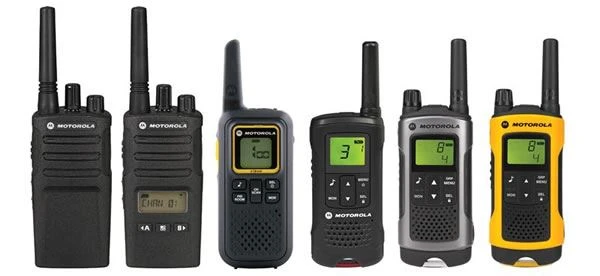
Browse our shop for an extensive range of licence-free radios and headsets from Motorola, Hytera, Icom and Kenwood, all at great prices and with FREE delivery to the UK on orders over £200.00.
You might also be interested in:
- Do I need a licence for a two-way radio?
- Free advice and application service for Ofcom licences
- Motorola launches its first waterproof, licence free walkie-talkie