

Long-range radios explained: How far can two-way radios really reach?
Many UK businesses – from security teams and logistics providers to marine vessels and event organisers – wonder how far two-way radios can transmit. Understanding this topic, and searching for the best long-range radios, is important to keep staff connected across wide areas.
This short guide explains what really affects range and how to choose the right setup for your site or team.
Jump to a specific section:
- What does “long-range” really mean?
- VHF vs UHF: Which reaches further?
- VHF strengths and weaknesses
- UHF strengths and weaknesses
- How obstacles affect range
- How power output and antennas affect range
- Antennas for handheld radios
- Antennas for mobile and marine radios
- Using repeaters and PoC to extend coverage
- When wide-area radio systems beat PoC
- UK licensing: How to stay legal and getter better coverage
- Which system works best for you?
- Quick tips to maximise range
- Summary checklist
What does “Long-Range” really mean?
“How far do two-way radios reach” isn’t a one-line answer. You’ve probably seen claims like “up to 10 miles” on packaging, but that’s only possible in perfect conditions with clear line of sight. Most users achieve far less.
In everyday UK environments, expect anywhere from half a mile to several miles, depending on several variables:
- Frequency band (VHF or UHF)
- Radio power output (Watts)
- Antenna height and quality
- Obstacles and terrain
- Weather and environment
For reliable long-range communication, you’ll usually need licensed radios, an external antenna, or a repeater to boost coverage.
To understand this a little better, radio wave frequencies above 2MHz travel in straight lines. This means they travel in a direct line (called line of sight) between the transmitting and receiving antennas.
Under normal circumstances, radios with these higher frequencies can’t travel beyond the horizon. To put it another way, the maximum communication distance (without any signal boosters) is an uninterrupted straight line from the radio to the horizon.
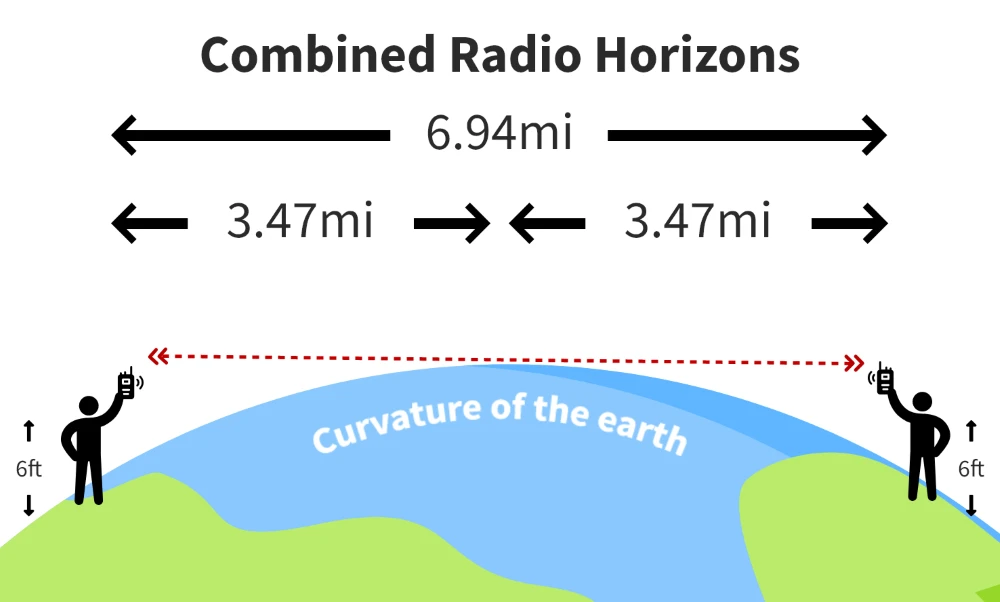
Of course, unless you’re at sea, the chances of such an empty landscape to the horizon is very low! There will be buildings, cities, rolling hills or mountains, obstacles that the radio waves have to go through. This is when the different behaviours of VHF and UHF signals affect the long-range capabilities of your radio.
Browse two-way radios in RadioTrader’s shop
VHF vs UHF: Which reaches further?
Two-way radios use either VHF (136–174 MHz) or UHF (400–520 MHz) frequencies. VHF and UHF signals travel and react to obstacles differently. This affects how far they can travel.
- VHF travels farther in open areas, over flat ground or water – great for outdoor sites such as construction, or for logistics, transport, and marine users.
- UHF penetrates buildings and dense sites where there are obstacles better – ideal for security patrols, events, or hospitality venues.
| Frequency | Strengths | Limitations | Typical Use |
|---|---|---|---|
| VHF | Long distance outdoors; fewer repeaters | Blocked by buildings/woodland | Marine, construction, transport |
| UHF | Better in built-up sites and indoors | Shorter overall reach | Security teams, events, hospitality |
The best range depends less on raw distance and more on where you work. If you’re unsure, RadioTrader’s team can recommend the right frequency band for your environment.
We’ve written in detail about VHF vs UHF radios in the past, but we’ll also sum up their strengths and weaknesses here:
VHF strengths and weaknesses
- Penetrates objects (e.g. non-metallic objects such as walls, stone, furniture, human bodies) better than UHF (both VHF and UHF generally won’t pass through metal or hills, however)
- VHF signals travel further (approximately twice as far as UHF, assuming line of sight with no barriers)
- Obstacles in built-up areas, buildings, or heavily wooded areas can block the VHF signal because of its longer wavelengths.
- Works best in outdoor conditions with clear line of sight, i.e. flat ground or open sea.
UHF strengths and weaknesses
- The shorter wavelength of UHF signals means it can navigate obstacles and small spaces better than VHF.
- Best for use in urban areas, heavily built-up sites, forests etc. with “dead” spots or no clear line of sight.
- A UHF signal doesn’t travel as far as VHF.
Taken as a single factor, then, VHF is better for longer distance communication, but don’t rush to buy a VHF two-way radio just yet! Depending on your environment, a UHF model might still be most effective for you.
How obstructions affect range
We’ve just said that VHF wavelengths are better at penetrating objects than UHF, but you should also know that each time any radio signal passes through an object, it gets a little weaker. Particularly dense objects leach more strength from the radio signal, which reduces the distance it can travel, so a radio transmission with fewer obstructions in its path will travel further than one without.
How power output and antennas affect range
A radio’s power output, measured in Watts, determines how strong its signal is – but only within legal UK limits.
| Radio Type | Output | Approx. Range* |
|---|---|---|
| Licence-free (PMR446) | 0.5 W | Up to 1/2 mile |
| Licensed handheld | 2 to 5 W | 1 to 6 miles |
| Vehicle/mobile radio | Up to 25 W | Up to 10 miles |
*Assuming good conditions and line-of-sight.
Hold your fire, though! Rushing out to buy a 5-Watt handheld radio or a 25-Watt mobile radio won’t necessarily mean you’ll get greater range. Antenna choice often makes the bigger difference.
- Whip antennas give the best range for handhelds.
- Stubby antennas are more compact but can cut distance by up to 30%.
- Vehicle and marine antennas, mounted high, can multiply range several times over.
See antenna options and upgrades
Antennas for handheld radios
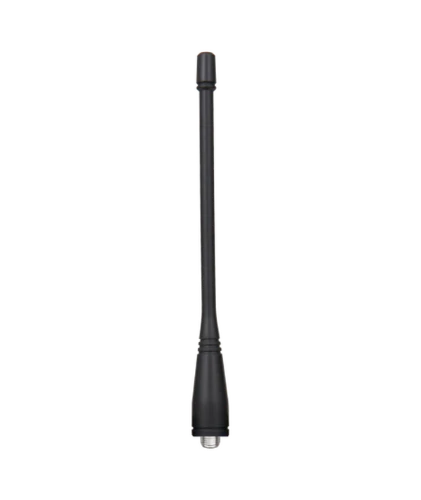
Handheld radios have two types of antenna - stubby and whip. As the name suggests, stubby antennas are short and discreet, so the radio is still small enough to slip unobtrusively into a pocket or clip comfortably to a belt. The downside is that a stubby antenna can reduce your range by up to 30% over whip antennas.
Whip antennas are several inches longer and they’re a better option to boost your communication range.
Antennas for handheld radios are often interchangeable, which is useful if you want to change a stubby antenna for a whip antenna to boost your range.
Antennas for mobile and marine radios
In vehicles, users usually mount mobile radio antennas on the roof or the boot, so they can extend several feet above the height of the vehicle. This extra height helps to considerably extend a radio’s range.
Marine radio antennas tend to be even longer, and mounted higher; the long-range abilities of a marine radio are significant when combined with an open sea and no obstructions to weaken or reflect the signal.
Using repeaters and PoC to extend coverage
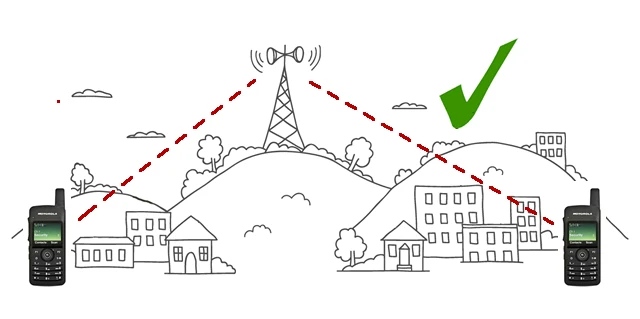
Radio repeaters
If terrain or buildings block your signal, a repeater can receive and re-transmit your signal at higher power, bridging obstacles and expanding coverage between users.
They’re mounted high, for example on rooftops or hills, and are common in large campuses, stadiums, or multi-site operations.
Professional installation ensures correct frequency pairing and coverage testing.
Explore repeaters and professional setup
Push-to-Talk over Cellular (PoC) - Unlimited range via 4G/5G
If your work spans cities or the entire country, PoC radios are a game changer.
They look and behave like normal two-way radios but connect via 4G/5G or Wi-Fi, giving almost unlimited range as long as there’s mobile data.
Key benefits
- Nationwide coverage (no repeaters)
- Simple set-up and scalable channels
- GPS tracking and dispatch options
PoC radios are ideal for logistics, transport, and event control rooms managing remote teams.
Explore Connect Plus PoC solutions
When wide-area radio systems beat PoC

Cellular coverage isn’t guaranteed everywhere. Repeaters remain better for:
- Remote or rural operations with patchy 4G
- Emergency services, logistics, transport – where reliability is mission-critical
- Sites needing private, licence-controlled networks
Consider hybrid systems that combine radio + PoC failover for resilience.
UK licensing: How to stay legal and get better coverage
Licence-free PMR446 radios are convenient for small-scale, short-range use with no expense, but they’re limited to 0.5 W power and fixed antennas.
For longer range, professional users can apply for an Ofcom business radio licence.
Common options include:
- Simple UK Light – shared nationwide licence for up to 5 W handhelds. Channels are shared.
- Simple Site Light – a licence for one-site operations like festivals or warehouses using radios powered up to 5 W.
- Technically Assigned – this licence assures you a dedicated frequency for larger, private systems, up to 25 W power.
- Area Defined – for county or regional coverage, a dedicated spectrum for variable power needs.
Read our guide on two-way radio licences
Which system works best for you?
Security & Facilities
- Use UHF for indoor penetration
- Position base stations centrally
- Consider repeater + PoC hybrid for larger estates
Events & Festivals
- Temporary mast or trailer-mounted repeater
- Mix handheld and mobile radios
- Ensure licence and frequency coordination
Construction and Logistics
- Blend vehicle mobiles (25 W) with handhelds (5 W)
- Mount antennas clear of cranes and steelwork
- Choose rugged IP67 models
Marine and Coastal
- Use VHF marine bands and long whip antennas
- Observe Ofcom and MCA licensing
- Consider PoC backup for offshore communication
| Environment | Recommended Solution |
|---|---|
| Urban / Security / Events | UHF radios or PoC over 4G/5G |
| Open countryside / Transport / Marine | VHF radios with tall antennas |
| Large or hilly sites | Licensed radios + repeaters |
| Multi-region operations | PoC (Connect Plus) or hybrid systems |
Need help choosing? RadioTrader can design a system tailored to your coverage area and budget.
Quick tips to maximise range
- Keep batteries fully charged
- Swap stubby for whip antenna
- Clean antenna connections
- Move to higher ground
- Switch to high-power mode when needed
- Mount antennas as high as practical
- Use a repeater for large or obstructed areas
- Test coverage in your environment before rollout
- Always use licensed frequencies for critical communication
The bottom line
There’s no one-size-fits-all “long-range radio”, but with the right combination of frequency, power, antenna height, and network support, you can achieve dependable communication across your site, event, or operation.
Summary checklist
- Choose VHF or UHF based on environment
- Consider licensed radios for reliable range
- Optimise antenna height and type
- Add repeaters or PoC for wider coverage
- Verify Ofcom licensing early
From a simple licence-free setup to a long-range radio system or a nationwide PoC system designed specifically for you, RadioTrader’s experts can help you find the best communication solution for your business.
Contact us now for free, expert advice.